
Overlooked Insurance Risk Is Costing Homeowners Thousands of Dollars a Year
Leonard Ortiz/MediaNews Group/Orange County Register via Getty Images
The property risks related to climate disasters and extreme weather are predicted to soar in the coming decades, but there is one risk the average homeowner is very likely overlooking.
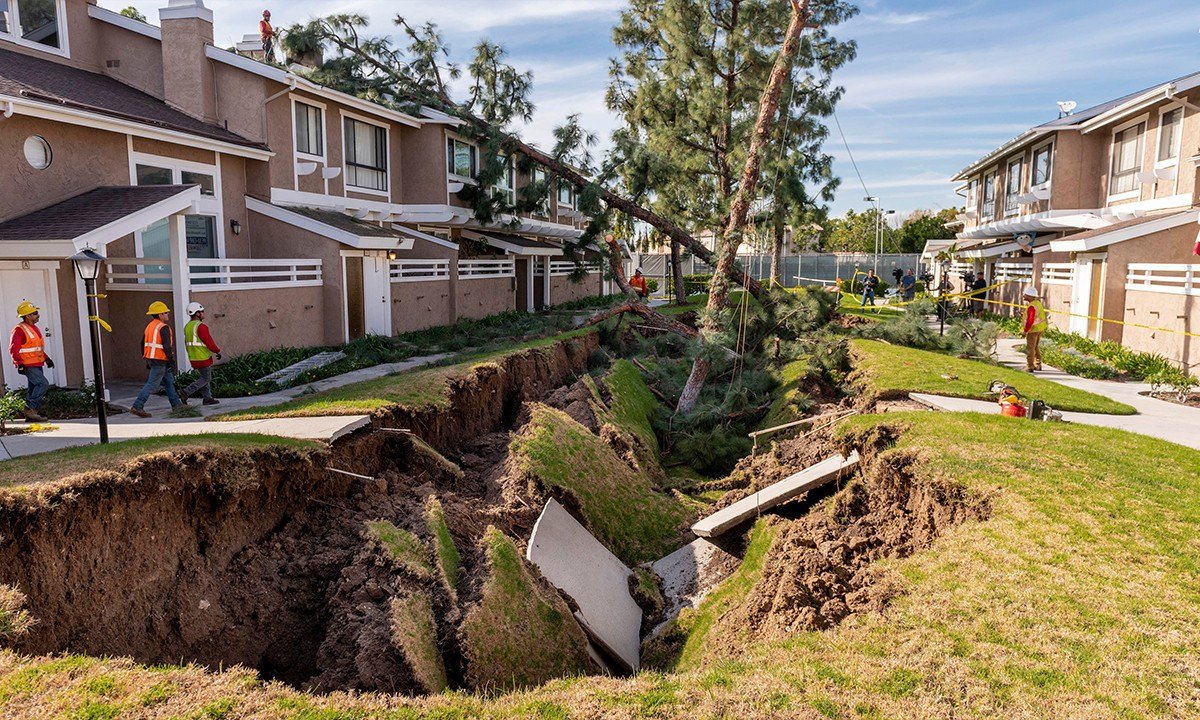
The risk? Sinkholes, a highly expensive nuisance. In 2020, the average sinkhole insurance claim in Florida was over $140,000, according to the Insurance Information Institute (III).
Sinkholes can also be deadly.
In one of the most widely reported tragedies due to a sinkhole, a man who was sleeping in his home in Seffner, FL, was pulled into a giant sinkhole and died as his brother desperately tried to rescue him.
“I opened up the door and there was a big hole there,” Jeremy Bush told Fox 13 in 2023. “His bed and dresser and everything was gone. He was gone.”
Bush said he immediately jumped into the hole to try to rescue his brother, Jeffrey, but was unable to.
“I started digging because I heard him yelling for me. ‘Jeremy, please help me.’”
The Bush family’s home on Faithway Drive, as well as two neighboring homes, were demolished and filled with gravel. Despite engineers fixing the hole, it opened up at least two more times.
What is a sinkhole?
Sinkholes are depressions in the surface of the ground caused by the sudden settlement or collapse of the land. They are a natural component of the landscape in many states.
“While the risk of a sinkhole is low, the fallout is potentially devastating to a homeowner,” says the III website.
Natural sinkholes tend to form where there is underground water that eats away at rock foundations, which is why they are common in states with lots of water, like Florida.
“Moving water dissolves small amounts of rock and carries it away, which enlarges natural pores and cracks in the bedrock,” says III. “Over time, as more and more limestone disintegrates, large cavities and caves form. When the land surface gives way to fill in the voids, a sinkhole occurs.”
While Florida is the state with the most sinkhole activity (about 6,000 per year) primarily concentrated in the Tampa Bay region, as well as “sinkhole alley”—Hernando, Pasco, and Hillsborough—they can occur anywhere.

(FDOT/FDEPMapDirect via ca.dep.state.fl.us)
They are especially common in Alabama, Kentucky, Missouri, Pennsylvania, Tennessee, Texas, and Florida, according to the U.S. Geological Survey. Other states aren’t immune.
Meanwhile, an 11-square-foot sinkhole opened up on a highway in New Jersey in February, shutting down three routes. It’s not yet known what caused the hole, but a nearby one that opened in December was caused by an abandoned mineshaft that collapsed.
The chances of a sinkhole opening on your property is 1 in 100 in any given year. However, the odds increase in a place like Florida.
While the USGS says there is not yet an efficient system to determine if there is—or isn’t—a sinkhole lurking on your property, there are ways to protect yourself and your home.
Avoiding sinkholes
If you are home shopping and want to know if a property is at risk, talk to your agent.
“A seasoned real estate agent that has covered an area that you are considering is a good place to start, but also local home inspectors would have awareness of the issue,” says Cara Ameer, a licensed real estate agent in Florida.
“You can do a deeper dive by consulting with a foundation specialist and/or a licensed geologist/soil engineer to get more information about the earth in the areas/communities you are interested in, and they can do an assessment of a property you are considering buying or currently own,” she says.
Florida’s Department of Environmental Protection has a map tracking reported “subterranean events, [which] can cause holes, depressions, or subsidence of the land surface that may mimic sinkhole activity.”
These are not necessarily true sinkholes but depressions in the earth that could be caused by many factors, such as flooding. These areas are most prone to opening sinkholes.
If you are concerned about it, you can find a licensed professional engineer specializing in soil subsidence or sinkholes to inspect the property.
Most local insurers can steer you toward companies with licensed sinkhole inspectors. Global engineering and consulting firms such as Rimkus and J.S. Held can also help.
Is your home at risk?
Look for these signs in your home:
- Cracks in the walls and floors
- Floors that are uneven or sloped
- Windows and doors that may be difficult to open and close
- Water leaks
- Creaking noises
- Nails that pop in the walls
- Cabinets and drawers that are difficult to open and close
- Moldings and trim work that appear displaced
Of course, all of these signs could merely be that your house is old. However, many of them taken together could mean you want to call a qualified professional who can inspect your property.
A general contractor or normal home inspector wouldn’t be qualified.
Are you already covered by your insurance policy?
“A standard homeowners insurance policy typically doesn’t cover damage caused by a sinkhole or other earth movements, such as a landslide or earthquake,” Mark Friedlander, head of corporate communications at III, tells Realtor.com®. “This is true in Florida and all other states.”
All U.S. home insurance policies list sinkholes as a standard exclusion. It is sold only as an endorsement (add-on).
While Florida’s catastrophic ground cover collapse coverage would likely cover you in the event of massive damage to your home caused by a sinkhole, this isn’t offered in other states.
Additionally, these four conditions must be met to be covered: abrupt collapse of ground cover; a depression in the ground cover that is clearly visible to the naked eye; structural damage to the building, including the foundation; and condemnation of the structure and order by government authorities that it be vacated.
If you are worried about your property and want to get sinkhole coverage added to your policy, then you can pay extra. In Florida, this costs approximately $2,000 to $4,000 per year.
Keep in mind that if geological testing reveals that sinkhole activity is present on the property or within a certain distance of the property to be insured, an insurer might decline to provide sinkhole coverage, says Friedlander.
Tennessee is the only other state that requires insurers to offer add-on sinkhole coverage.
If you are concerned, an additional endorsement to your policy can be purchased in most states. The two states where it isn’t offered at all are California and Hawaii.
Costs can vary, so talk with your insurance agent.
Should you worry about a sinkhole?
While the headlines are scary, the odds of your home being swallowed by a sinkhole are extremely low.
“Would I be worried about a sinkhole? Probably not,” Wendy Maddalone, communications director for Security First Insurance in Florida, tells Realtor.com.
Sinkhole claims from 211 insurers in the Sunshine State rose from 2,360 in 2006 to 6,694 in 2010, totaling 24,671 claims throughout that period for a total cost of $1.4 billion, according to a Florida State Senate report.
However, lots of litigation and subsequent insurance reforms meant a massive drop-off in those numbers.
In 2023 in the Sunshine State, according to the Florida Office of Insurance Regulation, there were 249,294 hurricane insurance claims, 13,964 lightning claims, and 3,370 falling object claims.
Sinkhole claims? 277.
“If it does happen, it is absolutely awful,” says Maddalone. “But would the possibility of it keep me up at night? No.”
Categories
Recent Posts


"My job is to find and attract mastery-based agents to the office, protect the culture, and make sure everyone is happy! "